
Evidence-Based Health for Women Over 40
Carol W., 59, watched the system "keep an eye on" her husband for six years. After the funeral, an ICU nurse told her the one thing about borderline numbers that nobody said while it still mattered. This is what Carol does differently now, before every meal, and why she makes her sister do it too.
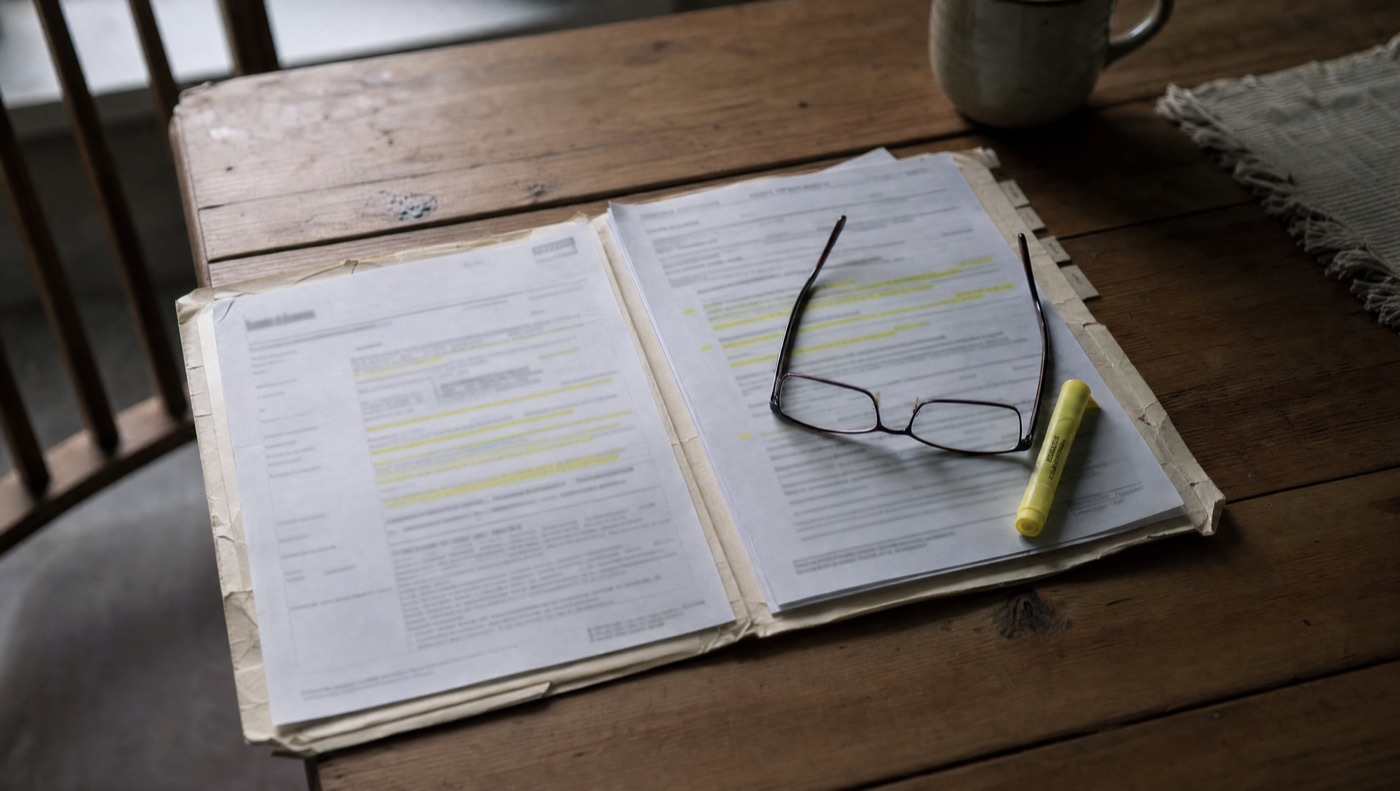
Tuesday morning, 9:40 AM, eleven days after the funeral. I sat down at my kitchen table with a cup of coffee I wouldn't drink, a yellow highlighter, and my husband's medical folder.
The folder is nine years old. Ray started it himself, back when keeping your medical papers in one place felt responsible.
The funeral home gave me their paperwork in a folder too. Navy, glossy, nicer than Ray's. I hate that I noticed that, and I noticed it anyway.
There's one page inside Ray's folder I haven't been able to show anyone yet. Not my sister, not Renata. I'm going to show it to you before this is over, because it's the whole reason I wrote this.
Manila, softened at the corners, his handwriting on the tab. Six years of annual physicals inside. Six years of the same word.
Borderline.
Slightly elevated. Trending up, worth watching. We'll keep an eye on it. Recheck in twelve months. Six different phrasings of the same sentence, twelve months apart, in the same doctor's system, about the same man.
Ray died on March 14th. A stroke, at 61, nine days after he'd told our grandson he'd teach him to drive a stick shift. The obituary said "suddenly." I've come to hate that word, because I've read the folder now, and there was nothing sudden about it. It took six years, and it was documented the entire time.
I was a wife for 34 years. Now I'm a warning. I'd rather be neither, but nobody asked me, so I'm going to be the loudest warning I can manage.
SEE THE READER PRICE →One serving before meals · 30-day money-back guaranteeI need you to see the years, because you're probably living in a version of them right now.
Every February, the physical. Every February, the same call afterward, Ray half-smiling with the phone at his ear: "Doc says I'm fine. Little high on the sugar numbers. Keeping an eye on it." Then he'd wink at me and have a second helping at dinner, because fine is fine, and the doctor said it.
One year they gave him a photocopied diet sheet. It went on the refrigerator under a magnet from our bank, and it stayed there so long it yellowed. It's still there. I can't take it down and I can't look at it.
One year they suggested walking, so we walked, most evenings, down Fenwick and back. He liked it. It wasn't nothing. It also wasn't the thing.
The last year, on his own, he bought one of those glucose monitors you wear on your arm, the Libre, $99 a month, with an app. He'd show me the graph after meals, this jagged mountain range on his phone, and we'd shake our heads at it like weather. Look at that spike, huh. Wild. We had the data. We watched the ride in real time, every day, on a screen. A speedometer bolted to a car that nobody ever told us had no brakes.
Here's what I can't get past, and I've had months of 3 AM to try: he did everything right. Every instruction, followed. Every appointment, kept. The system never failed to see him. It saw him six times, wrote it down six times, filed it six times.
The night it happened, in the ER hallway, a doctor I'd never met asked me the question I will hear for the rest of my life:
"How long had his numbers been trending up?"
I said I wasn't sure. I said something about borderline. He nodded in a way that wasn't really a nod and went back through the doors, and some animal part of me understood right then, in that hallway, at 3 in the morning, that the question had an answer, the answer was in a folder on our filing cabinet, and it had mattered the whole time.
And one more thing from those years that I didn't understand until after. The summer before, Ray had a cut on his heel he never felt. Wore his boots all weekend over it. We joked about his tough old feet. Nobody joked in the wound clinic eight months later. Feet go quiet years before anything gets a name. That's the kind of thing the drifting years are doing while everyone's calling you fine.
Her name's Renata. She was Ray's ICU nurse at the end, the one who brought me coffee I didn't drink and stayed four minutes past every reason to leave. In May she called to check on me, because apparently some nurses do that. A Thursday. Friday, actually, because the recycling bin was still at the curb while we talked and I kept meaning to go get it. I asked her the question I couldn't ask anyone else.
Six years, Renata. Borderline for six years. How?
She was quiet for a second, and then she said, "Can I tell you the thing I'm not supposed to say on a recorded line?"
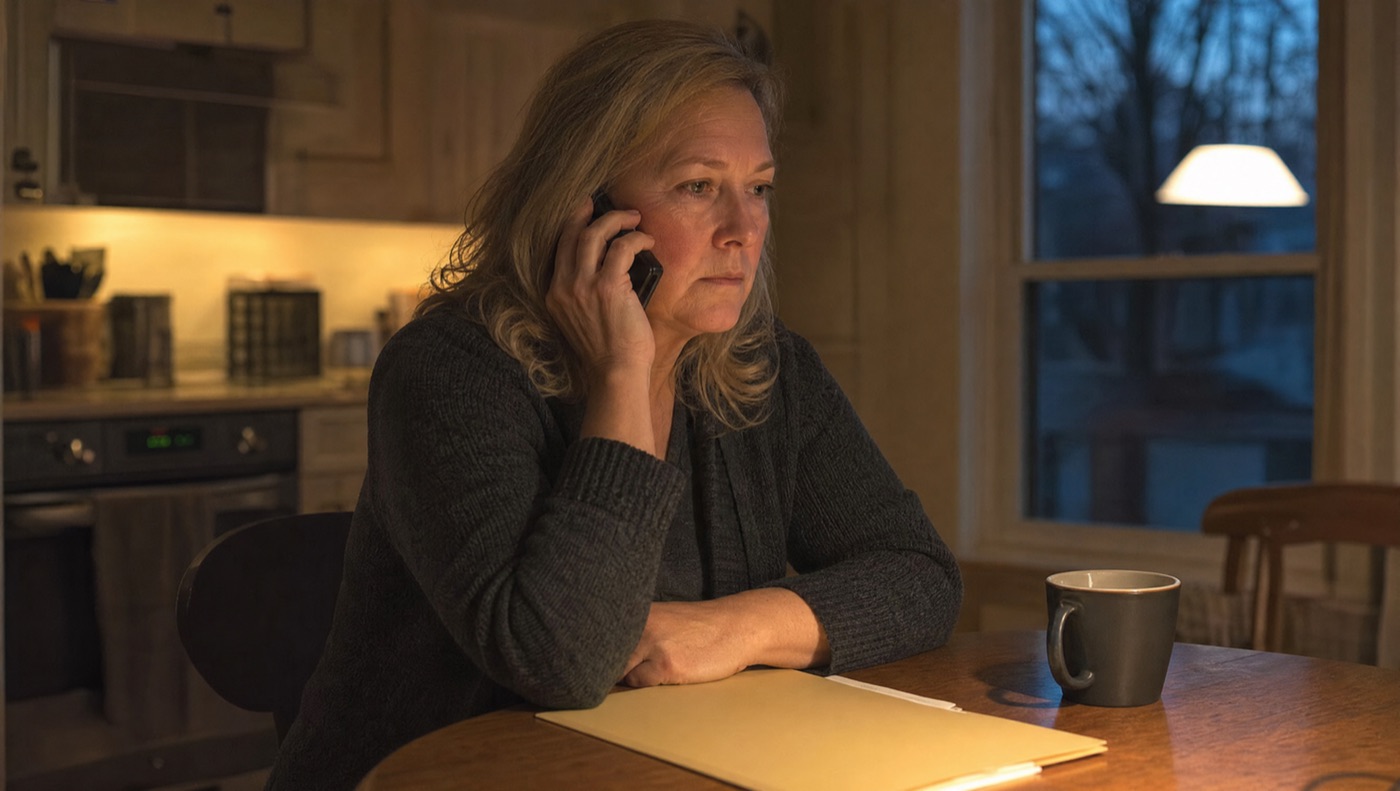
"Borderline years are not neutral years. That's the lie in the word. The whole time a number is drifting, the swing underneath it is doing quiet work, on vessels, on nerves, on the heart, and none of it announces itself. Medicine has a speed limit. We're allowed to act at diagnosis. The years before diagnosis, the years that decide nearly everything, belong to nobody. His folder wasn't a record, Carol. It was a countdown, and everybody who opened it read it like a weather report."
Then she told me about the ride itself, and I'm going to give it to you straight, because you're not fragile and neither am I.
After middle age, every meal spikes your blood sugar harder, and what goes up crashes down. The crash makes the cravings and the exhaustion everyone blames on age. The spike side signals your body to store, which is the weight. A typical swing after an ordinary lunch can run 42 points. And the swing compounds, steeper every year it runs, doing its quiet work the entire time, in exactly the years everyone calls you fine.
The 3 PM wall Ray hit in his recliner every afternoon for a decade. The night snacking we teased him about. The belly he patted like an old dog. The graph on his phone we watched like weather. One thing. It was all one thing, wearing costumes, for six documented years.
So before you read another word, go do one thing. Find your own bloodwork. Not today's number, the last four or five years of labs, lined up oldest to newest, and read the same line straight across, left to right, like a sentence. If the word repeats, or it climbs even a little, you can stop reading this as Ray's story. You're standing somewhere in the middle of the same six years right now, and you can't feel it, which is exactly the point.
Then I told her what I'd done that morning, because I'd been waiting to tell someone: I'd pulled my own folder. Three years of my own physicals. And there, in my own numbers, creeping the same direction, the same word.
Renata didn't do anything dramatic. She just said, "Okay. Then you're the one I'm actually calling about. Do you have a pen?"
What she gave me was a before-meal habit. Ten to fifteen minutes before eating, a specific combination of plant compounds that work on the swing from four directions at once, so the spike that makes the crash and the storing and the quiet damage never fully forms. She called it closing the gate before the meal, and she's blunt about why a phone call from a nurse is where I heard it: nothing about it can be patented, so nothing about it gets marketed, so it lives in journals and break rooms instead of appointments.
That night I made a decision at the kitchen table, out loud, to a house with nobody in it. I would not let the drift have me the way it had him, and I would not let it have Jean, or my daughter, or anyone I still had left to lose.
So I did the honest thing first, exactly what Renata said. I bought all four. Separate bottles, inulin and berberine and cinnamon and bitter melon, sixty-some dollars, four labels shouting four different amounts. Then I tried to take them before every meal, three times a day. It was a mess. Four things to swallow, no way to know if the doses even added up to what she'd described, a pill organizer that looked like a tackle box. I lasted nine days. On a fixed income and a widow's memory, four bottles before every meal isn't a plan, it's a way to quit by the end of the month and tell yourself you tried.
By then I'd crossed off everything else too, the expensive way. The diet sheet had yellowed on the fridge. The evening walks were lovely and they weren't the thing, because nothing you do after a spike closes the gate in front of it. The $99 monitor was a camera pointed at a crash. One ingredient is one door, and the spike has four. And waiting for a doctor to be allowed to act is just the polite name for how six years disappear. Cross all of that off, and there is exactly one thing left standing.
The capsule Renata takes herself, and gives her own mother, is all four doors in one, with the amounts already worked out. It's called Glyco Optimizer, by GlycoBalance. One capsule, ten minutes before a meal, about $1.50 a day. I know there are other jars on the shelf with four things on the label, I stood in the aisle and read them with my glasses on. Half of them won't tell you how much of anything is inside, and after Ray I will never again trust a number nobody bothered to write down. This one lists the amounts and uses the standardized extracts, which is the whole difference between a label and a dose.
And I know how this sounds. A sad story about a dead husband, and here comes the pill. If your gut is telling you a dollar-fifty capsule can't matter when the serious-looking answers are a $99 monitor and a $350 injection, hold onto that gut, because it is the exact instinct that cost us six years. The expensive thing looked like medicine. The cheap thing looked like nothing. We bet on the one with a sales rep. And the cheap thing stays quiet for the same reason it stays cheap: there is nothing in it anyone can patent, so nobody makes the kind of money that buys commercials. The price and the silence are the same fact.
I'll be straight with you the way I wish someone had been with us. I'm not a doctor, and I won't insult Ray by telling you a capsule saves lives. What I can tell you is what I've watched at my own table. My afternoons came back the first week. Jean started after a month of watching me, and my daughter, 41 and already told she's "a little high," takes it now too. Three of us in one family, all headed a different direction than Ray. That isn't a study, it's just the truth I have, and I would rather hand it to you than keep it.
Here is the part I would want someone to say to me, so I'm saying it to you. You've read this now. You know what the drifting years do, and you know there's a ten-second habit that meets them head on. If you close this and do nothing, that is not the same as Ray closing his eyes to it, because Ray was never told. You were. It was also the first thing I did in this entire story that needed nobody's permission, no prescription, no appointment, no line to cross before anyone was allowed to care. Whatever your next set of labs says, and whoever ends up reading them for you one day, that is a choice you're making at this table tonight, with the same information I had.
See what Carol takes before every meal now →And now the page I promised you, the one I couldn't show anyone. It's from Ray's 2021 physical. His number had just crossed into "borderline" for the first time, and on the plan line, typed, it says: "Recheck in 12 months."
That's the whole page. That was the entire plan, in writing, at the exact moment there was still time. Four words and a date. I've read whole articles about what could be done in the years before the line, and his plan line had room for four words.
THE PAGE WHERE JEAN AND I ORDER IS HERE →One capsule before meals · No prescription · 30-day money-back guarantee"I lost my Tom in 2023. Same word, same folder, same everything. I read Carol's story with his picture on the table and ordered before I finished it. Week 6, and my numbers just came back better for the first time in years."
"I bought it for my husband, who is Ray in this story except still here. He takes it before dinner because I put it next to his fork. Whatever it takes."
"49 and 'borderline' as of last month. My mother's road, my grandmother's road. This article is why the road ends with me. Day 12, the afternoon crash is already gone."
"Retired paramedic, 30 years. The hallway question the ER doctor asked her is the question we all carry. I take this before meals and I make my brother take it. Believe the boring parts of this story, they're the truest ones."
"My sister and I split the 4-pack. We call it dinner insurance. Neither of us has had an afternoon crash in a month, and honestly the peace of mind is the product."
Your treatment belongs to you and your doctor, and nothing in my story is an invitation to change one word of it. Never stop or swap a prescribed medication because of an article. What I'd say, widow to whoever's reading: bring the before-meal idea to your doctor and ask. Ray taught me what silence between appointments costs. Ask everything.
I asked Renata almost exactly this, because grief tells you everything is too late. She said the window is whatever years you have in front of you, and the swing is doing its work in every one of them you leave it alone. I'm 59. I plan on a lot of Februaries. That's the math.
The $12 bottle is one ingredient at one door. This is four ingredients covering the meal from four directions, which is why the cheap bottle did nothing for the neighbor who lent me hers, and why I didn't bother with half measures. My folder doesn't get half measures anymore.
Ray's monitor was $99 a month and it was a spectator. His last ambulance ride was $2,900 and it was nine minutes. The injections everyone talks about run $350 a month. This is $1.50 a day, and it's cheap for the same reason nobody ever told us about it: no clinic, no rep, no patent. The price and the silence are the same fact.
30-day money-back guarantee, and I'd use it without shame, because I did the math before I ordered too. My honest telling: the scale gave me nothing for two weeks and the afternoons changed in one. Give it the month before you judge, then decide with your own folder.
The monitor that watched Ray's ride and stopped nothing: $99 a month
Nine minutes in an ambulance: $2,900
The injections at the end of everyone's road: $350 a month
Glyco Optimizer retail: $79 a bottle
Reader price, 3-bottle-plus-1-free package: $47.26 a bottle
Jean and I both take it before every meal and it is the cheapest line item in my kitchen. The recheck story takes 8 to 12 weeks, which is why the package comes sized for the distance.
I know what some of you are doing right now, because I would have done it too. You're deciding this story is sad but not yours, because his numbers were his, and yours are only a little high, and your husband's are only borderline. Read that sentence back. That is word for word what Ray and I said, in those words, for six straight years.
The thing I actually think about at 3 AM isn't the stroke. It's that Ray had promised our grandson he'd teach him to drive a stick shift, nine days before, and that lesson is never going to happen. You have one of those too, whether you've let yourself name it or not. A wedding, a graduation, a trip half-planned in a drawer. Picture the chair at it with nobody in it. That isn't morbid. It's just the appointment the drifting years are quietly making while everyone keeps calling you fine.
And if you can't do it for yourself yet, do it for whoever's labs scare you more than your own. Order theirs. Put the bottle next to their fork the way Jean does for her husband, the way I wish I'd known to do for Ray. You'll be taking it yourself by the end of the week. It always goes down easier when it starts as love for someone else.
You've got a drawer somewhere with your last few years of labs in it. You know exactly which one. The only question left is what the next set says, and who ends up reading it for you.
P.S. It's early Tuesday as I finish this. Jean called twenty minutes ago to tell me her new bottles came, and she said to tell whoever reads this that the sister discount is you split the 4-pack. Ray's folder is put away in the hall closet now. Mine stays on the kitchen counter, next to the bottle. My next physical is in February. I'm ready for this one.
SEE IF THE CURRENT BATCH IS STILL IN STOCK →Glyco Optimizer by GlycoBalance · take before meals© 2026 Hormone Weekly. This is an advertorial and not a news article. The story above is a dramatization drawing on composite reader and customer experiences; names, medical details, and identifying details have been changed or combined, and the persons depicted are not actual individuals. This story does not claim, and should not be read to claim, that any supplement prevents, treats, or reduces the risk of stroke, diabetes, or any disease or medical event. Individual results vary and results depicted are not typical. Hormone Weekly receives compensation for purchases made through links on this page.
These statements have not been evaluated by the Food and Drug Administration. This product is not intended to diagnose, treat, cure, or prevent any disease. Never start or stop any prescribed medication without consulting your physician. If you have a medical condition or take medication, talk to your doctor before using any supplement.
Every bottle comes with a 30-day money-back guarantee. If it does nothing for you, you send it back and pay nothing. The only thing that costs you anything is waiting.
Read the guarantee →
Comments (118)